
Engineering the G Series Suspension
When designing the 2026 Optibike G Series, Jim Turner didn’t just want a bike that was fast; he wanted a bike that felt “rock solid” at 35 miles per hour. In a recent technical discussion, Turner revealed how the design of the rear swingarm and shock geometry has changed the game for high-performance ebikes.
For riders with previous injuries or those tackling aggressive off-road terrain, suspension isn’t just a luxury—it’s a necessity for safety and comfort. Here is how Optibike is approaching ebike suspension differently than the rest of the industry.
The Science of the Leverage Ratio
One of the most critical aspects of the G Series is the leverage ratio. Jim Turner explains that the way the shock is leveraged relative to the rear wheel determines the ride characteristic. Many lower-quality ebikes act like a “pogo stick,” offering no real damping or progression.
Optibike tuned the G Series to have a specific curve:
- Flat Performance at the Start: This keeps the bike stable and prevents “pedal bob” when you are putting power down.
- Plush Progression: As the suspension moves through its travel, it gets stiffer to absorb massive hits without bottoming out.
Stability at 35 MPH: The “Bridge of Doom” Test
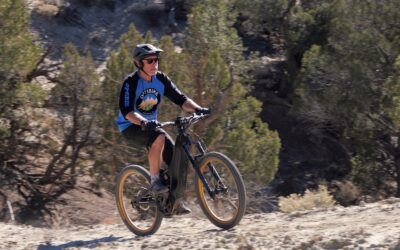
A common issue with lightweight ebikes is that they feel “scary” or “twitchy” at high speeds. Brandon Mason notes that the G Series feels like a dedicated downhill mountain bike, even when hitting speeds of 35 mph.
“These bikes at 35 miles per hour, you don’t even think you’re going 35,” Turner says. “It’s rock solid. You should be feeling something, but you aren’t.”
This stability was tested on Colorado’s “Ridge of Doom,” a 45% grade route usually reserved for downhill mountain bikers. While others struggle to go down it, the G Series is engineered to ride both up and down with total control.
Packaging High Travel with Low Standover
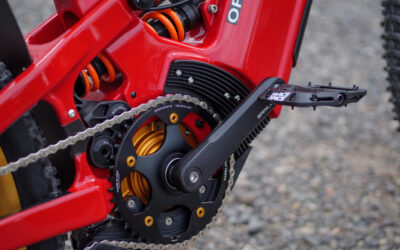
One of the hardest engineering feats in bike design is fitting a high-travel suspension system into a frame with a low standover height. Most bikes sacrifice one for the other. By redesigning the swingarm to move backward during compression, Optibike has achieved a massive amount of travel (170mm) while keeping the bike accessible for shorter riders.
The “One Complaint” Philosophy
Jim Turner’s approach to manufacturing is famously uncompromising. He recalls a story from the early days of Optibike when he told his team he only wanted one specific complaint from customers.
“I want one complaint from people: It’s too expensive. A terrible complaint is, ‘It’s scary,’ ‘It handles like crap,’ or ‘I don’t have fun.'”
This is why every Optibike is built with top-tier brakes, wheels, and tires. There are no “garbage parts” or low-quality components. When you are traveling at high speeds off-road, the quality of your equipment is the difference between a great ride and a dangerous one.
Experience the difference of precision engineering. Visit Our Bikes to explore the G Series and see why it is the benchmark for ebike suspension performance.

0 Comments